top of page


Press Room
The Doppelgängers of the Sea: A revision of sea sponge species in the Northeast Pacific reveals cryptic introduced species
St. Andrews, New Brunswick, Canada – October 1, 2026
Accurately identifying look-alike sponge species helps scientists better understand marine biodiversity and unlock their potential for medicine and conservation.

Would you guess that the two sea sponges pictured above are different species?
Despite their similarities, they are. If you had trouble telling them apart, you’re not alone!
Even experienced taxonomists – scientists who identify, describe and classify species – cannot always distinguish some sponge species based on appearance alone. In many cases, even microscopic examination is not enough to separate them.
How do scientists identify sea sponges?
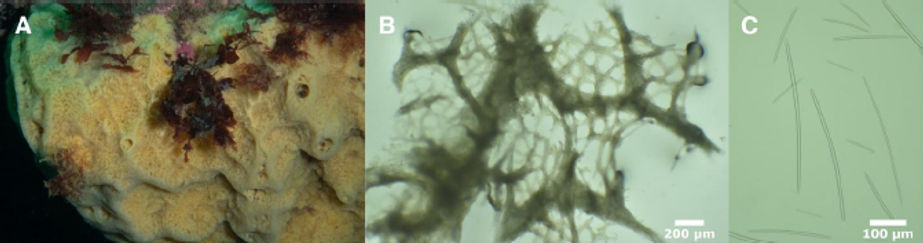
Traditionally, taxonomists identify sponge species by examining their morphology, or physical characteristics. This often involves studying tiny skeletal structures called spicules and their arrangement.
However, some species are so similar in appearance that these characteristics alone cannot reliably distinguish them. In these cases, researchers use DNA sequencing alongside traditional morphological methods to accurately identify species.
“There are around 8500 sponge species known to science, but we think there could be twice that many in the oceans” – Dr. Claire Goodwin, Research Scientist and Taxonomist, Huntsman Marine Science Centre
Using DNA to uncover new species
Sponge species are genetically distinct, which means that each species has a different DNA blueprint. By comparing DNA sequences, taxonomists can detect differences that may not be visible under a microscope.
“When combined with traditional morphological taxonomy, DNA sequencing gives us another tool to distinguish species that appear almost identical,” explains Dr. Claire Goodwin.
These molecular techniques have revealed that some sponges previously thought to belong to a single species are actually multiple, genetically distinct species. A recent effort published within the peer-reviewed journal Bulletin of the Society of Systematic Biologists, and including Huntsman Marine researchers, described numerous new cryptic species from specimens previously believed to represent a few known sponge species.
Accurate species identification is particularly important because many sponge species produce unique bioactive compounds that are being investigated for pharmaceutical applications, including antibacterial and anticancer drug discovery. Correctly identifying the species helps ensure these compounds are attributed to the appropriate organism.
The danger of look-alike sponges
Sea sponges are sessile marine animals that live attached to the seafloor. Because they cannot move away from predators or competitors, they produce a wide variety of chemical compounds that help defend themselves and interact with their environment. Many of these naturally occurring compounds have attracted scientific interest because of their potential medical applications.
Some similar sponge species are known as cryptic introduced species. These species are genetically distinct from native species but closely resemble them in appearance, making them difficult to detect using traditional identification methods alone.
Because they can easily be mistaken for native species, cryptic introduced species may go unnoticed during ecological monitoring. Identifying them accurately helps researchers better understand species distributions, detect non-native introductions, and monitor changes in marine ecosystems.
Why are they so similar?
Sea sponges are among the oldest animal groups on Earth, with ancestors dating back more than 700 million years. Although they have evolved remarkable diversity in their biology and chemistry, many species still share relatively simple body structures, which presents challenges to their identification.
The sponge family Halichondriidae is one example. Several species within this family produce compounds of pharmaceutical interest, yet many possess similarly simple spicules and loosely organized skeletal structures that are difficult to differentiate under a microscope.
Looking ahead
Although DNA sequencing has become an invaluable tool for modern taxonomy, not every ecological monitoring program has access to this technique and thus many rely on morphology-based identification.
Expanding access to molecular identification methods would improve scientists’ ability to detect cryptic species, monitor introduced species and better understand our marine biodiversity. It would also provide greater confidence when studying the pharmaceutical potential of sea sponges by ensuring that bioactive compounds are linked to the correct species.
As researchers continue to uncover hidden biodiversity beneath the ocean’s surface, they are discovering that many familiar-looking sponges are not what they first appeared to be. Recognizing these cryptic species provides a more accurate picture of marine ecosystems and helps scientists better understand, protect, and sustainably use the remarkable biodiversity found in our oceans.
Research Publication:
Turner, T.L., C. Morrow, B. Picton, C. Goodwin and R.W. Thacker. 2025. A common garden of Halichondria sponges: Taxonomic revision of Northeast Pacific Halichondriidae reveals many cryptic introduced species. Bulletin of the Society of Systematic Biologists 4. https://doi.org/10.18061/bssb.5811
Image 1: These two images are sponges that are both in the Genus Hymeniacidon, a sponge species within the family Halichondriidae. More specifically, image ‘A’ to the left is the species Hymeniacidon kitchingi and image ‘B’ to the right is the species Hymeniacidon pierrei sp. nov. (sp. nov. indicating that it’s a newly named species). The latter has recently been reclassified as Rhaphidostyla pierrei following a revision of these genera.
Image 2: The sponge species Halichondria akesa as shown in a field photograph (left), tangential section showing the ectosomal skeleton and subectosomal spicule tracts (centre), and its oxeas spicule (right).
Story by Hannah Breneol, The Huntsman Marine Science Centre
For additional information or images relating to this article, please email huntsman@huntsmanmarine.ca
Return to our Press Room for more stories!
bottom of page